“That Little Extra Spark”: Cesar “Rico” Rodriguez and the F-15 Eagle
Aug 13, 2025
Capt. Cesar “Rico” Rodriguez looked to his left. He saw the other airplane up close: green and brown camouflage and a bright Iraq flag painted on the tail. No doubt about it: That was a MiG-29, the top-of-the-line, most advanced Soviet-designed fighter in operation, and it was targeting him. Rodriguez turned his F-15C Eagle and the two aircraft became immediately locked in a two-turn dogfight: each chasing the other’s tail in a downward spiral, flying at about 600 miles per hour. The fight started low, at about 8,000 feet above the ground, and as each pilot strained to pull in on the circle to get a firing position, they raced closer and closer toward the desert floor.

This was his first air-to-air live combat engagement, but Rodriguez was an experienced fighter pilot. “The maneuver reminded me a lot of things that we had done in basic training, Red Flag training, everything,” he said when interviewed in 2025. But there was one key difference from training: “Now, one of the two of us was going to employ a weapon. For me, it was not going to be him.”
Over his whole career, Rodriguez destroyed three enemy aircraft in combat, making him one of only four Americans to get that close to achieving “ace” status (shooting down five aircraft) since 1972. Two of his victories happened in the same jet: F-15C serial number 85-0114, which was added to the Smithsonian’s National Air and Space Museum collection in 2025 and is now on view at the Steven F. Udvar-Hazy Center.

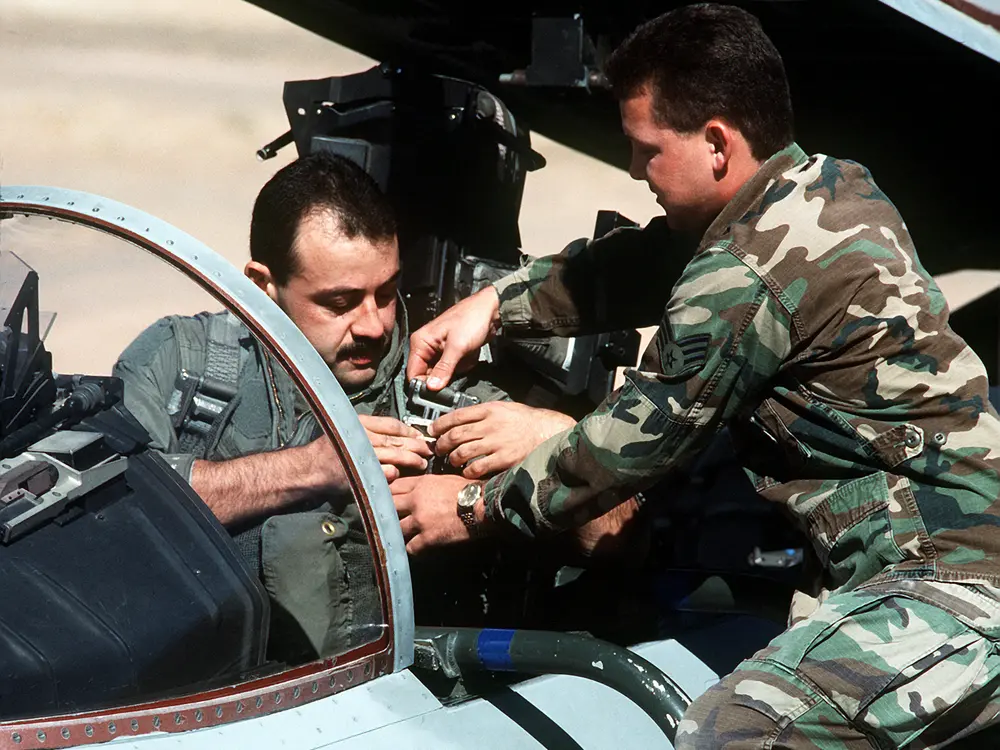
Inspired by his U.S. Army officer father, Rodriguez joined the U.S. Air Force and got his wings in 1982. He initially struggled with flight training in T-37s and T-38 Talons to the point that one of his instructors told him flat out: “you kinda suck.” But that same instructor worked with Rodriguez to develop a plan to improve so that he could achieve his dream of becoming a fighter pilot. The specific airplane didn’t matter at first, until he went to an airshow and saw the F-15 Eagle. “Wow, that looks pretty badass,” he said. “So that became my goal.”
He first flew A-10 Thunderbolt IIs for two years, then worked as an instructor pilot in AT-38s. But in 1988 he joined the 33rd Fighter Wing and finally got his chance to fly the Eagle. His first time in an F-15 was unforgettable: “Just starting the airplane was a very exhilarating experience. You just started to feel this raw power…. It talked to you,” Rodriguez said. “All of the aerodynamics of the F-15 came to play, and you could feel it. It was really an amazing experience.”
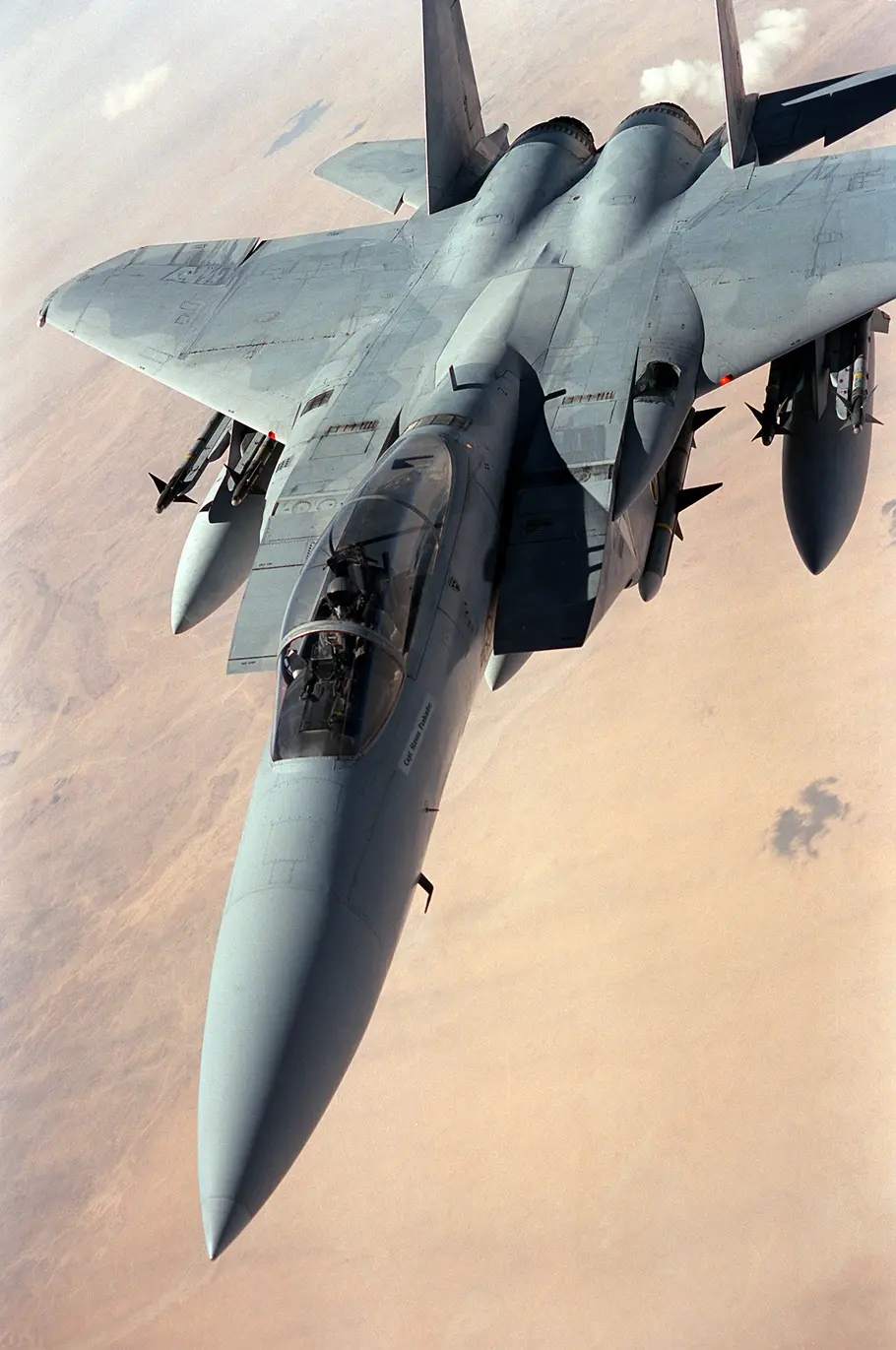
In August 1990, Iraq’s military invaded the nation of Kuwait, and U.S. forces deployed to the region immediately. When Iraq’s leader, Saddam Hussein, refused to withdraw, the U.S. formed a massive international coalition and led a military effort to drive Iraqi forces out of Kuwait. The prospect was daunting. Iraq had the fourth largest military in the world at that time, including an advanced air defense network, Soviet-designed weapons, and about t300 aircraft. Those included about three dozen MiG-29s, the advanced Soviet-designed fighter that American analysts considered “roughly the technological equivalent of the U.S. F-15.”
When Rodriguez arrived in Kuwait, he found that flying in a tense combat theater was a lot like training, but with one key difference: in training, there were “red guarded switches” on, and no one fired live weapons. With those switches open, “that part really started to spark the adrenaline. Now we’re going to war,” he said. It also raised “the uncertainty factor…. You start to wonder, are you good enough to do this?” Rodriguez found himself facing some difficult questions: “Are you prepared to do everything you’ve been trained to do? To the level that might require you to kill somebody?” he asked himself. It wasn’t something that had been discussed much in training. “There’s nothing in the world that prepares you for that,” he reflected later. And it didn’t get easier. Having had to make those decisions in multiple combat events, Rodriguez emphasized, “None of them prepares you for the next one.”
These questions became real for him on January 19, 1991, three days after the official start of the Gulf War. While flying a defensive mission with three other F-15s, intelligence came in about a suspected weapons storage facility southwest of Baghdad. He and his formation headed that direction to help provide protection for a strike group. While en route, his radar picked up incoming MiG fighters about 12 to 14 miles away. Rodriguez and his wingman, Capt. Craig “Mole” Underhill, chased the MiGs north, until they got a warning that surface-to-air missiles (SAMs) were starting to track them—these enemy fighters might be trying to lure them into a trap. Just then, an Airborne Warning and Control System (AWACS) aircraft called them and said there were enemy fighters to the west, coming at them.
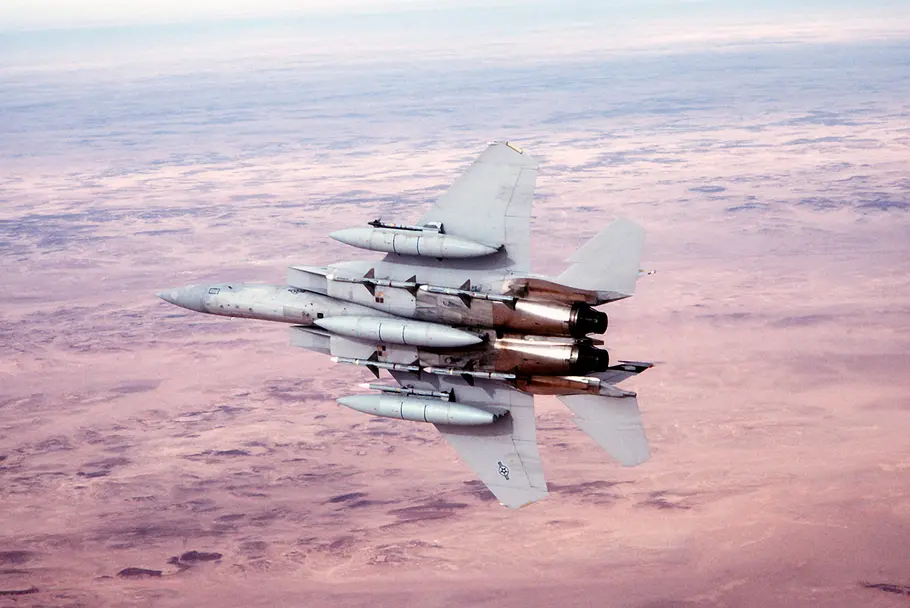
“Out of instinct,” Rodriguez recalled, he “slammed the throttles to full afterburner. I pulled 9-9.5g’s in the turn” towards the new threat. One of them, a MiG-29, got a lock on Rodriguez. He pulled away and started throwing chaff into the sky to shake the MiG’s lock on him as he told Underhill to lock onto the MiG. Underhill launched an AIM-7 Sparrow and the missile arced over Rodriguez and slammed into the nose of the MiG-29, erupting in a massive fireball. “He didn’t realize my wingman was better than he was,” Rodriguez recalled.
As they were announcing their victory, AWACS broke in again—more MiGs were flying to the north. Rodriguez and Underhill turned to find them and picked up the new target about 10 miles away. But there was a problem: Rodriguez’s system showed the target as hostile, but Underhill’s showed it as friendly. The only way to be sure to avoid a friendly fire incident was to get a visual ID. That’s when Rodriguez got close and pulled up to see the distinctive shape and markings of the Iraqi MiG-29, and their double-turn spiral towards the ground began.
As both aircraft pulled tighter in the circle, Rodriguez thumbed his switch to turn on the AIM-9 Sidewinder heat-seeking missile. There was too much interference from the heat of the ground to get a lock. The turn pulled nine Gs, pressing against his body with incredible force as he pulled in even closer and thumbed the switch to the AIM-7 Sparrow radar-guided missile. Straining against the G forces, Rodriguez was close – only 1,500 feet behind the MiG, close enough for guns, which rarely happens in modern aerial combat. But the ground was rushing up to meet them, the two aircraft chasing each other down. Now they were less than 1,000 feet above the rocks.
Suddenly the MiG inverted and dove down—what looked like the beginning of a “Split-S” maneuver. The MiG pilot was trying to escape, but must not have realized how close to the ground they were. Rodriguez was well aware of the approaching rocks and pulled up. The Iraqi pilot lit his afterburners and immediately slammed into the ground at full speed. “The fireball just rolled forever,” Rodriguez said. “It probably tumbled for a couple of miles.” He did not see the enemy pilot eject. Rodriguez had managed to defeat the Iraqi pilot through sheer maneuvering, without firing a weapon.

Exactly one week later, Rodriguez was flying near Baghdad again when AWACS called with a warning of enemy aircraft to the west. With three other F-15s alongside, the American pilots set up an “F-15 wall.” Eagle pilots had developed tactics to take advantage of the long-range radar capabilities of the jet. One of the main practices was called “target sorting,” where each member of a formation takes responsibility for a target. The four F-15 pilots divvied up the three MiG-23s that were racing toward them.
The two lead F-15s each took a shot against two of the MiG-23s. As those missiles flew, Rodriguez fired a third: an AIM-7 Sparrow. The lead missile didn’t explode but did hit the front MiG; the pilot tried to maneuver but the plane quickly caught on fire and went down. The other two MiGs turned towards the F-15s, putting them closer to the missiles that were already in the air. The second missile tore into the next MiG at almost the same time Rodriguez’s missile slammed into the third. “Both of our missiles are direct head-on impacts to the MiG-23s,” Rodriguez said. “They both literally disintegrate in space right then and there. There was no debris field. All it was, was a big char mark straight down onto the desert floor.” None of the MiG pilots ejected.
Only later did Rodriguez realize that the jet he was flying that day, by sheer chance, was 85-0114—the exact same Eagle he had flown when he defeated the MiG-29 a week earlier. Military pilots don’t often fly the same jet, even if their names are painted on the side. “You would fly whatever jet you were given,” Rodriguez said, due to maintenance and operation schedules. He remembered, “It didn’t even cross my mind” that it was the same airplane. “It wasn’t until we got home and the crew chiefs put two stars on the airplane,” that he realized the significant coincidence. He joked: “Wow, 114 needs to be my airplane when we get done with this war!” But he also emphasized that his success was truly a team effort. “So many different individuals and career fields touched 114,” he said, from maintenance crews to loaders, to refuelers, to base security and many more. All are essential. “It should mean something to all of us,” he said, “and I know it does.”
Both Rodriguez and 114 had long careers after the Gulf War. The airplane later served with the 44th Fighter Squadron, based at Kadena Air Base in Japan, and then flew with the 114th Fighter Squadron as part of the Oregon Air National Guard’s 173rd Fighter Wing before being transferred to the National Air and Space Museum to join the Smithsonian’s collection. Rodriguez also had a successful career, shooting down another MiG-29 in March 1999 during Operation Allied Force, eventually retiring as a Colonel.
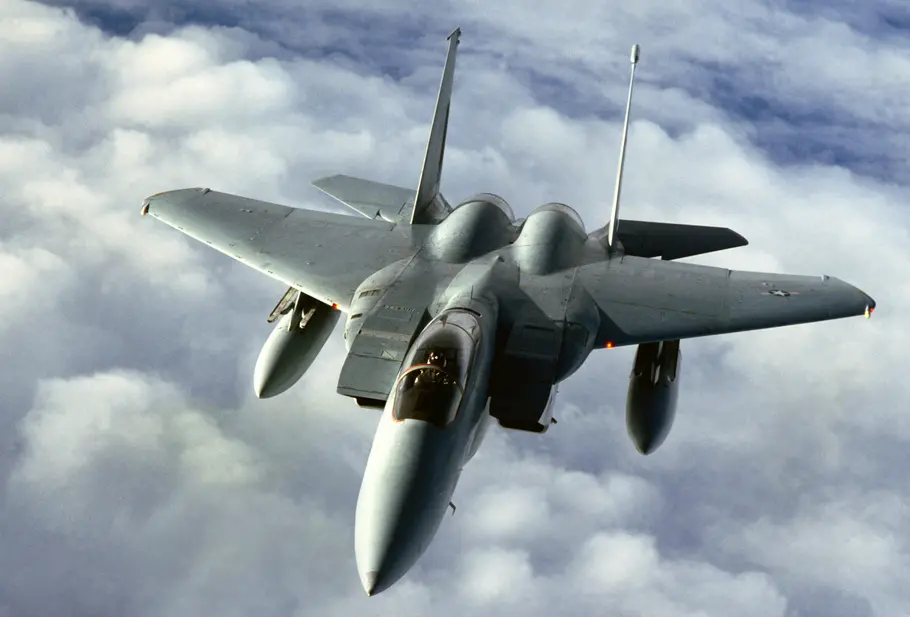
The U.S. Air Force retired its remaining F-15C Eagles from active duty in 2025. These aircraft leave behind a powerful legacy. At the time of its design and development, the F-15 epitomized the American approach to military aircraft design: advanced, cutting-edge technologies that were highly sophisticated and highly capable, but also came with a high cost. The Eagle’s technology was optimized for the role of air-to-air combat, in which it excelled. Looking at all nations that have flown F-15s, Eagles have shot down over 100 enemy aircraft in combat, while not one single F-15 has ever been lost in air-to-air combat due to enemy action. Aircraft 85-0114 is just one example of how the Eagle became one of the most iconic symbols of American military aviation in the late 20th and early 21st centuries.
Rodriguez said he didn’t usually look at the tail number of the jets he flew. But, “Whenever I did get to fly 114, there was just that little extra spark, that little extra jump in my step,” he remembered. “Ok, we’re back together again!”
Related Topics


Support the Museum
We rely on the generous support of donors, sponsors, members, and other benefactors to share the history and impact of aviation and spaceflight, educate the public, and inspire future generations. With your help, we can continue to preserve and safeguard the world’s most comprehensive collection of artifacts representing the great achievements of flight and space exploration.
Support the Museum
We rely on the generous support of donors, sponsors, members, and other benefactors to share the history and impact of aviation and spaceflight, educate the public, and inspire future generations. With your help, we can continue to preserve and safeguard the world’s most comprehensive collection of artifacts representing the great achievements of flight and space exploration.