

Barnstorming
What Was Barnstorming?
Barnstorming refers to how pilots, both men and women, flew to anywhere with an open field to put on daring air shows after World War I. These aviators, known as barnstormers, gave rides to the public and attempted all sorts of stunts. These spectacles in the skies spread excitement about flying among their audiences. This “airmindedness” joined corporate sponsorships and developing aviation technologies to popularize barnstorming.

The Most Popular Barnstorming Plane
Curtiss JN-4D Jenny
The U.S. Air Service used the Curtiss JN-4D Jenny during World War I, but its more significant role in aviation history was as a barnstorming and mail-carrying airplane in the 1920s. Large numbers of inexpensive war surplus Jennys were available in the United States after 1918. Its affordability, ease of operation, and versatility made the Jenny the signature airplane of the barnstorming era.
The Thrill of the Air Show
What Was it Like to Have a Barnstormer Come to Town?

Hubert Julian, showman and promoter of Black aviation, points to a billboard announcing his appearance in a “Colored Air Circus” in Los Angeles in 1931.
Imagine heading down to the nearest open field in your hometown. When you look to the sky in the distance, you see a person walking along the wing of an aircraft while the pilot tries to keep it steady. For a small fee, you can see this act and more up close. During the barnstorming era, this was the sight people saw when an air circus or barnstormer came to town. Public flights captured the attention of audiences before WWI in the form of races, meets, and competitions. After the war, barnstormers brought entertainment to rural towns through shows and rides.

Danger and Precarity
Despite Americans enjoying their shows, barnstormers continuously put their lives in danger while performing. Often, they were killed, disabled, or injured in hospitals for months. Barnstormers also experienced a similar sense of instability on the ground. As gig-workers, they depended on the fees that they collected for their shows and rides to pay for their expenses, including housing, food, and the use of local fields as runways.
Types of Barnstorming Stunts

Wing Walking
Performers would walk on on the wings of aircraft and perform other acrobatics while another pilot would remain at the controls of the aircraft to keep it steady. In some cases, pilots would wire the controls in place and leave them completely. Here, Ormer Locklear performed a wing-walk, including doing handstands on his Jenny.

Transfers
Barnstormers also tried to jump between planes in mid-air and from aircraft into cars. Often, they failed. Clyde Pangborn missed the automobile driving under his plane to transfer. He fell on the ground in Coronado Tent City, Coronado Beach, California, 1920.

Parachuting
Barnstormers also dove off from their aircraft. Georgia "Tiny" Broadwick parachuted first from air balloons and then planes.
The Barnstormers
Many barnstormers were veterans of the U.S. Army Air Service in World War I. As a whole, barnstormers hoped to establish themselves financially and gain popularity through showing off their aviation skills. They worked independently or joined air circuses where they worked within a troupe. Many set records, raced, and performed stunts for movies. Meet a few of them below.
Ormer Locklear
Ormer Leslie Locklear was trained in the Army Air Service in Fort Worth, Texas and served during World War I. After his discharge, he barnstormed and became known for performing the first wing walk when he reattached a loose radiator cap. Later, he did stunts in Hollywood for movies that spotlighted aviation including The Great Air Robbery (1919) and The Skywayman (1920).
-
Slide 1 of 4
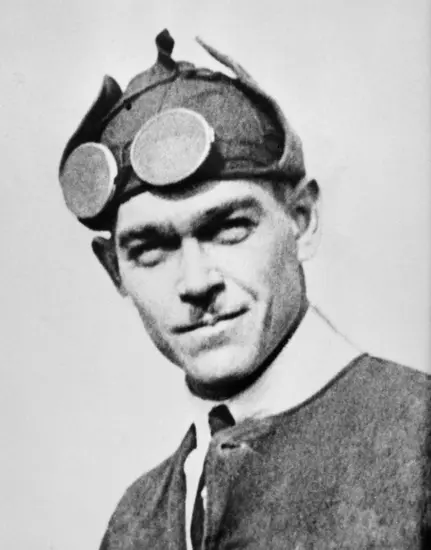
A portrait of Omer Locklear.
-
Slide 2 of 4

Barnstormers like Locklear relied on promotional material like this newspaper advertisement to spread the news about their shows.
-
Slide 3 of 4

Locklear was well known for wing walking.
-
Slide 4 of 4

Here, Locklear and his flying partner Milton Elliot crash into a church spire as part of a stunt for the film The Skywayman. Both died tragically while filming another stunt for the same moving picture in 1920.


Bessie Coleman
“Do you know you have never lived until you have flown?”
Bessie Coleman received the first pilot’s license issued to an African American or Native American woman. After training in Europe, she worked as a barnstormer and speaker. Coleman was supported by Black audiences, especially women, who provided hospitality and safety in a segregated United States.

Roscoe Turner
Roscoe Turner first was an air balloon pilot during World War I. He later barnstormed throughout the South on his Jenny. His success as a racing pilot and in motion pictures got him to land commercial sponsors such as the Gilmore Oil Company, Pump Engineering Service Co., Ring-Free Oil Company, and others. Turner was notorious for adopting a lion cub named Gilmore who flew with him.

Ruth Law and her Flying Circus
“Fear and daredevilry are the two greatest dangers in aviation.”
This pioneering woman led a 3-plane flying circus that raced, flew alongside fireworks, and set aviation records. Law, among the first women to get a pilot’s license in the U.S., was a careful but persevering aviator. She set multiple records as first person to fly at night publicly and the first woman to wear a military uniform but could not fly in combat. Law served in WWI by promoting bonds and raising money for the Red Cross by “bombing” the nation with leaflets.
More Barnstormers & Performers

Born as Georgia Anne Thompson, "Tiny" joined a traveling circus as a parachuter after witnessing one jump. At the time, the 15-year-old was working in the cotton mills and raising a child as a single mother. Listen to the podcast to learn how she jumped out of hot air balloons and airplanes before barnstorming became popular.

Spencer moved to Chicago from his home state of Virginia to learn how to fly. He worked in a kitchen to pay for his lessons. Shortly, he captivated audiences through barnstorming. Read the blog to learn how he parachuted off planes and advocated for Black pilots through the Goodwill Flight in 1939.

Lindbergh became a barnstormer after World War I, flying through the Midwest as a young man. Later on, he made history when piloting the Spirit of St. Louis from Long Island, New York to Paris, France on the first non-stop solo flight across the Atlantic in 1927. He became the face of aviation as he used his fame to promote excitement about flight.

Banning grew up in a Black homesteader family in Oklahoma. He took his first flight as a young man when an air circus came to town in 1920. Read this blog to learn about how he performed in an air circus and worked with Thomas Allen to become the first African-Americans to complete a transnational flight in 1932.
The Barnstormer Fit in the Collection
If you wanted to be a barnstormer, you needed the proper flight attire and safety equipment. Below find some examples of what a few famous barnstormers wore.
Documenting Barnstorming
Barnstormers and others took care in documenting performances and accomplishments. They took photos to advertise future appearances but also collected keepsakes and newspaper stories for personal archives.

A US Air Service photographer stands in a biplane holding a small French camera, most likely an Appareil 13x18-260 Modele 1916.
Cameras were used in aerial photography to capture both Earth and people below by the early 20th century. This included military reconnaissance to take pictures of enemies while in the air. Army photographers used cameras, like the Appareil 12x18-260 Modele 16, to complete these missions on planes and air balloons. However, these camera were also later used to document barnstormers' personal and professional moments.
Roscoe Turner likely acquired a similar camera, the Appareil 13x18-260 Modele 16, in France when he was a ballooning pilot in the French Air Division from 1918-9. The hand-held camera was used to take promotional aerial photographs of Turner's 1920s barnstorming act and to take commercial photographs by aiming over the side of an open-cockpit airplane.
Barnstormers could also be crafty and hands-on with assembling their personal archives. Ruth Law kept an extensive scrapbook. It held pasted newspaper clippings, correspondence, photographs, advertisements, personal notes, and keepsakes like ribbons from competitions. The book also documents some of Law's interactions with the women's suffrage movement. She included a yellow rosette labelled "Votes for Women."

Page from Ruth Law’s Scrapbook, featuring yellow “Votes for Women” rosette at the bottom and editorial cartoon underneath red aviator ribbon.

Air Commerce Act of 1926: Regulating Flight
Early on, pilot skills varied, and planes were not always reliable. That changed in 1926 when the government began licensing pilots, mechanics, and aircraft through the Aeronautics Branch of the Commerce Department. This was the predecessor of today's Federal Aviation Administration. The rules cramped barnstorming. But people started to take aviation seriously.
New Paths for Barnstormers
Barnstormers and other aviation performers often pivoted to new, more exciting, or just more stable opportunities. These included policing, entertainment, industry, and also illegal smuggling.

Laura Bromwell was the first woman to serve in aerial law enforcement as a pilot. She joined the New York Police Department’s Aviation Division Reserve with the rank of Lieutenant. She also set a record of 199 consecutive loops while barnstorming in 1924 before dying in an exhibition flight accident two weeks later.

Pancho Barnes was born as Florence Leontine Lowe and married before she went on her (mis)adventures in aviation. She learned how to fly in California, founded a labor union to protect fellow stunt pilots in films, and tested airplanes for companies like Lockheed Martin. Towards the end of her life, she ran her Happy Bottom Riding Club which attracted nearby military aviators in the Mojave Desert.

With access to surplus airplanes, trained aviators turned to the underground economy to earn some money or to feel the thrill of smuggling. Barnstorming could be a cover for traveling to remote areas at odd times. These pilots flew in alcohol during the Prohibition, narcotics for organized crime, and people attempting to migrate as the U.S. government imposed increased immigration restrictions. Many pilots were caught but these acts did not ruin their reputation.
