
Who is the Man That Discovered the Universe?
Jun 24, 2025
By Damond Benningfield
A century ago, Edwin Hubble began the race to the edge of the cosmos.
On a snowy New Year’s afternoon in 1925, on the campus of George Washington University in Washington, D.C., astronomer Henry Norris Russell read a paper submitted by Edwin Hubble.
It would change the universe.

Tweed jackets and pipes were lifelong affectations that Hubble first embraced while studying at Oxford University.
For several decades, astronomers had been debating the nature of spiral nebulae—pinwheel-shape objects twirling across the heavens. One view held that the spirals were clouds of gas and dust that were part of the Milky Way galaxy (then thought to constitute the entire universe), with our solar system at the center. Others argued that spiral nebulae were so-called island universes: separate systems of stars much like the Milky Way. The truth about spiral nebulae would determine whether the universe spanned a few hundred thousand light-years—or millions.
Hubble’s paper provided the best evidence to date of the more expansive view. According to Hubble’s calculations, the only two spirals visible to the naked eye—the Andromeda Nebula (also known as Messier 31) and the Triangulum Nebula (Messier 33)—were more than 900,000 light-years away.
“Finding the scale of the universe and our Milky Way’s place in it was a fundamental challenge,” says Barry Madore, an astronomer at the Carnegie Institution of Washington and the University of Chicago. “Identifying island universes as individual galaxies of enormous size and great distance was a major paradigm shift.”
It wouldn’t be the last time Hubble would shift the paradigm. In 1929, he reported that all but a few galaxies are moving away from us, with more-distant galaxies moving faster than nearby ones. The discovery led to the realization that the universe is expanding, and that it must have had a beginning: the Big Bang. “Hubble is known as a titan in astronomy, especially American astronomy,” says Samantha Thompson, the Phoebe Waterman Haas Astronomy Curator at the National Air and Space Museum. “He was successful at pulling things together and getting us over the big hump of acknowledging two things: the Milky Way is one of many galaxies and the universe is expanding.”
“A hundred years ago, Edwin Hubble started the race to the edge of the universe,” says Ray Villard, news director for the Space Telescope Science Institute in Baltimore, which oversees both the Hubble and James Webb space telescopes. “He fired the starting gun, and the past 100 years have been a marathon to go as far across the universe as we can go.”

A six-letter word
If a person’s life can be judged by the objects that bear their name, then Hubble is a huge success. There’s a school named for him in Illinois, a highway in Missouri, a planetarium in Brooklyn, and a crater on the moon. The U.S. Postal Service even issued a stamp with his likeness.
For scientists, however, perhaps nothing surpasses becoming part of the daily language of their field, and Hubble’s name is emblazoned across astronomy and cosmology: Hubble’s law, the Hubble constant, the Hubble sequence, and others.
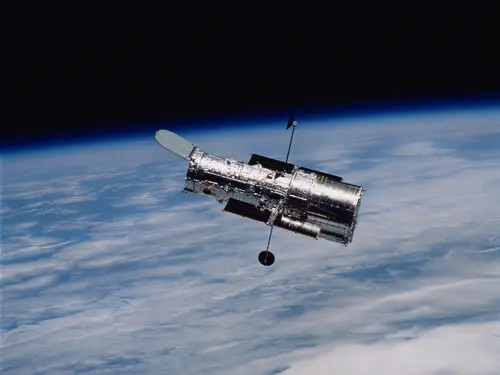
Above all—quite literally—is the Hubble Space Telescope. Over a 35-year span, its observations have helped scientists determine the age of the universe, estimate the rate of expansion, and discover dark energy—all extensions of Hubble’s work. “The telescope has really lived up to the contributions of its namesake,” says David Spergel, president of the Simons Foundation in New York, which supports research in mathematics and the basic sciences.
The telescope’s name has become a powerful brand, says David Soderblom, an emeritus astronomer at the Space Telescope Science Institute. “Wherever you go, people know the name. The only thing that comes close is probably Coca-Cola.”
Outside astronomy, however, few know the man for whom the telescope is named. “I don’t know that people understand that this was a real person,” says Thompson. “ ‘Hubble’ just becomes a six-letter word.” That’s unfortunate, because the man was as colorful as the images captured by the telescope. “He was an amazing character with an amazing variety of interests,” says Hasan Padamsee, a retired professor of physics at Cornell University in Ithaca, New York, who in 2010 wrote a play about Hubble, A Big Bang Beginning.
Edwin Hubble was born in Marshfield, Missouri, in 1889. His grandfather built him a telescope for his eighth birthday and the youngster stayed up all night to watch the stars. In high school, he was a good student and a better athlete, playing basketball and football and setting an Illinois state record in the high jump. Throughout his life, he was described as handsome and athletic.
Hubble earned a scholarship to the University of Chicago. He wanted to study astronomy, but his father, an insurance agent, forbade it, instead wanting him to pursue law. Still, Hubble took astronomy classes and served as a laboratory assistant to physicist and future Nobel Prize winner Robert Millikan. Hubble also played on the Chicago basketball team that won the 1908 national championship.
“Hubble was bound and determined from his youth to be famous,” says Timothy Thompson, science director at California’s Mount Wilson Observatory, where Hubble did his seminal work. “If he hadn’t been famous as an astronomer, who knows—he might have become famous as a basketball player.”
Hubble studied law at Oxford on a Rhodes scholarship, although he still maintained hopes of a career in astronomy. “He was biding his time as much as anything, hoping against hope that some turn of events would prompt a change in his father’s attitude,” according to Gale E. Christianson’s 1997 biography, Edwin Hubble: Mariner of the Nebulae.
Law degree in hand, Hubble left England, but England never left Hubble. “He never gave up the English accent, he never gave up the tweeds, he never gave up his pipes,” says Timothy Thompson.
Hubble did, however, give up the law. And when his father died, he was finally free to pursue the stars. He earned a Ph.D. at the University of Chicago while studying nebulae at Yerkes Observatory in Wisconsin. “I like that he was a bit stubborn,” says Isabelle Marinov, author of a 2018 children’s book about Hubble, The Boy Whose Head Was Filled with Stars. “He always knew what he wanted, he always knew what his passion was. He realized his dream.”
At the outbreak of World War I, Hubble rushed through his doctoral thesis (“the worst I’ve ever seen,” protege Allan Sandage said decades later) and enlisted in the U.S. Army, but he didn’t deploy to Europe until late in the war. Hubble reported that he briefly saw combat and suffered a minor injury, but there is no record of either, wrote Christianson.

The beautiful, but skewed, spiral galaxy NGC 1961 is about 190 million light-years from Earth—in the constellation Camelopardalis. During Hubble’s era, astronomers debated whether such formations were part of the Milky Way or separate “island universes.”
A brick through a window
Prior to the war, Hubble had received a job offer from Mount Wilson, which overlooks Pasadena. Founded in 1904 by the Carnegie Institution, Mount Wilson was the world’s preeminent observatory at the time, housing the largest telescopes: a 60-inch reflector and the 100-inch Hooker reflector, which reigned as the world’s largest telescope from its completion in 1917 until 1949. “Hubble was the right person at the right place at the right time with the right tools,” says Samantha Thompson.
Viewed through less powerful telescopes, nebulae appeared small and fuzzy. But the Hooker enabled Hubble to see more detail, including individual stars in some of the spirals. He searched for stars that changed brightness, which offered the best shot at measuring great distances.
Before then, astronomers could measure the distances to stars only with a technique called trigonometric parallax, whereby they looked at a star when Earth was on opposite sides of the sun.
Nearby stars shifted a tiny bit compared to the background of more-distant objects. (To see how it works, hold a finger in front of your face and look at it with first one eye, then the other; the finger shifts against the background. The farther your finger, the smaller the shift.)
Even the nearest stars are so remote that the angle of the shift—the star’s parallax—is tiny, so it’s difficult to measure. At the turn of the century, astronomers had good distances for only 60 some nearby stars, says Timothy Thompson. (Today, parallax can yield distances out to tens of thousands of light-years.)
Astronomers needed a new technique to extend the distance scale. That technique was provided by Henrietta Swan Leavitt, a female “computer” at Harvard College Observatory. She studied a class of stars known as Cepheid variables. Such stars are big, heavy, and brilliant. They’re also unstable, so they pulse in and out like beating hearts, causing rhythmic changes in brightness.
Leavitt discovered that brighter Cepheids take longer to brighten and fade than fainter ones. So, by measuring a Cepheid’s period, astronomers could determine its distance. When they finally calibrated the distances to a few Cepheids with parallax, they could determine the distance to almost any Cepheid within range of their telescopes. And because Cepheids are intrinsically brighter than most stars, “in theory, you could see them beyond the borders of the Milky Way,” says Samantha Thompson. “This was revolutionary.”
Astronomer Harlow Shapley, who had arrived at Mount Wilson a few years before Hubble, applied Leavitt’s technique to his own observations. By mapping Cepheids in the ball-shaped agglomerations of stars known as globular clusters, Shapley expanded the diameter of the Milky Way galaxy from the generally accepted value of no more than 30,000 light-years to 300,000 (modern measurements place it at about 100,000). Shapley placed the sun roughly halfway toward the galaxy’s rim instead of at its middle—another revolutionary discovery.
“Shapley believed he had finally mapped the distance scale for the entire universe,” says Timothy Thompson. “He thought they knew it all now.” Indeed, Shapley defended the position in what would become known as the 1920 Great Debate at the Smithsonian Institution, but skeptics were not convinced. It would fall upon Hubble to settle the matter.
Hubble plugged away at the problem with the help of one of the great photographic observers in the history of astronomy, Milton Humason. An eighth-grade dropout, Humason had worked as a mule driver and janitor at Mount Wilson. He quickly learned how to guide a telescope and how to expose and analyze glass plates, enabling him to record thousands of images.
On the night of October 5, 1923, Hubble captured an image of H335H, which showed three bright stars he hadn’t seen before. He initially labeled all three “N” for “nova,” a term that refers to stars that rapidly increase in brightness. He shuffled through the observatory’s plate archive, however, and found that one of them had brightened and faded over a period of 31.4 days. In red ink, he wrote “VAR!” next to the star on the discovery plate—an indication that it was a Cepheid variable.
“It’s the only scientific artifact I know of that shows human emotion,” says Soderblom, who arranged for astronauts to carry copies of the image on the 1990 Space Shuttle mission that placed the Hubble telescope in orbit. He later led an effort to have the telescope make an image of Hubble’s famous Cepheid.
From the Cepheid’s period, Hubble calculated the distance to the star—and, therefore, the Andromeda Nebula—at 930,000 light-years. (Present-day measurements place it at 2.5 million light-years; the difference is due in part to the fact that there are different types of Cepheids, which wasn’t known at the time.) Hubble circulated his findings to key astronomers, including Shapley, with whom he had an adversarial relationship. “Shapley said, ‘It destroyed my universe,’ ” says Villard. “It was a brick through a plate-glass window.”
“With Shapley’s discovery, the Milky Way galaxy became a thing we could measure, not just talk about,” says Timothy Thompson. “With Hubble, the universe became a thing that we could measure.”
On November 23, 1924, the New York Times became the first publication to report on Hubble’s discovery. The newspaper used an all-caps headline followed by a subhead: “Finds spiral nebulae are stellar systems. Dr. Hubbell [sic] Confirms View That They are ‘Island Universes’ Similar to Our Own.” Hubble formally presented his findings to other astronomers at a meeting of the American Astronomical Society on January 1, 1925.

Astronomers today still use Hubble’s classification scheme for galaxies, which he published in 1926.

Known as the Hubble sequence, galaxies are categorized based on their shapes: elliptical, spiral, or lens-shape.
Einstein’s endorsement
Thanks to his discoveries, reporters soon learned the correct spelling of “Dr. Hubbell.” As the years progressed, his fame grew. By 1926, Hubble had observed enough galaxies that he developed a classification scheme for them—the Hubble sequence—which categorizes galaxies based on their shape: elliptical, spiral, or lens-shape. (Although Hubble mistakenly thought the sequence indicated the evolutionary path of a galaxy, his scheme is still used today.)
The discovery that most cemented Hubble’s celebrity status was his finding that other galaxies are moving away from us, with those that are farther moving faster. In 1930, when Albert Einstein visited Mount Wilson Observatory, he expressed his support for Hubble’s findings. Although Hubble’s discovery of an expanding universe was in keeping with Einstein’s Theory of General Relativity, the famed German physicist had previously resisted the idea, placing his belief in a static universe. Einstein would later call this the “greatest blunder” of his career, and his endorsement of Hubble made the astronomer the toast of Hollywood. Hubble and his wife, Grace, hosted or visited the likes of Charlie Chaplin, Igor Stravinsky, William Randolph Hearst, and Cole Porter. They joined director Frank Capra at the 1937 Academy Awards, where Hubble received an ovation.
Hubble’s discovery of an expanding universe was built upon the observations of Vesto M. Slipher, an astronomer at Lowell Observatory in Flagstaff, Arizona. Using a 24-inch telescope, Slipher had measured what’s known as the red-shift of several galaxies. The technique, called spectroscopy, spreads the light from a visible object into its individual wavelengths or colors. Each chemical element in the object leaves a unique imprint in the resulting spectrum, like a barcode. Motion shifts the wavelengths of the different chemical elements. Objects that are moving toward us are shifted to shorter, bluer wavelengths, while those that are moving away are shifted to longer, redder wavelengths. The size of the shift depends on the object’s velocity.
Slipher found, for example, that the Andromeda galaxy was moving toward Earth, but the other spirals he measured were moving away—far faster than anyone expected, suggesting they weren’t bound to the Milky Way.
Hubble and Humason measured the red-shift of many more objects. When Hubble combined these findings with Slipher’s, he developed what is known as Hubble’s law: The farther a galaxy, the faster it is moving away from us.
“Initially, Hubble didn’t credit Slipher’s data,” says Samantha Thompson. “He had corresponded with Slipher, so it’s clear he was aware of what Slipher was doing. That’s always been a criticism—Hubble took other people’s work without giving proper credit.”

The Hubble Space Telescope embodies the spirit of its namesake, who once said: “The search will continue. Not until the empirical resources are exhausted, need we pass on to the dreamy realms of speculation.”
Hubble refused to accept that the increase in velocity was caused by the expansion of space itself (due to what became known as the Big Bang), attributing it instead to an artifact of the curvature of space. “Many people didn’t think the universe had an origin or was changing in any way,” says Samantha Thompson. “It was, and it always was.”
Even so, Hubble was the first to measure the expansion rate, known today as the Hubble constant. He found that for every million parsecs (3.26 million light-years), the velocity of expansion increased by roughly 300 miles per second.
Modern measurements, including those acquired by the Hubble Space Telescope, have hit the brakes, detecting a rate of roughly 40 miles per second. Yet there is no concordance on the exact number, with different techniques yielding differences of a few miles per second. That might sound insignificant, but the Hubble constant is one of the most hotly debated topics in modern cosmology. “If the discrepancy is real, it suggests that something is missing from our models of how the universe behaves on the largest scales,” says Spergel. “If it persists, it’s pointing to new physics, and that’s what gets people interested.”
“We’ve got a problem,” adds Madore, speaking from the Las Campanas Observatory in Chile, where he’s in the middle of a campaign to refine the distance to the galaxy M83 by using Cepheids and other types of stars. “Theorists are working on trying to modify [the model of the universe] with all sorts of very imaginative plausible and implausible ways. Clearly, they’re excited about it because there’s a Nobel Prize awaiting if they can figure out a plausible way of doing it.”
Hubble had hoped to win a Nobel Prize of his own. “He should have won the Nobel—he was top notch,” says Padamsee. “But at that point in history, astronomy wasn’t considered worthy of the prize. One of those quirky things about [Hubble] is he tried to convince the committee there should be a prize for astronomy.”
Hubble campaigned to include astronomy in the physics category, and published reports say the selection committee was planning to award him the prize in 1953. But he died shortly before the prize was announced, and it isn’t awarded posthumously.
While Edwin Hubble’s name isn’t among the esteemed roster of Nobel Prize recipients, it remains a vibrant presence in astronomy, immortalized in textbooks, cosmological equations, and in the telescope that has given us so many spectacular views of Hubble’s expansive—and expanding—universe.
Damond Benningfield is a science writer and audio producer in Austin, Texas.

This article, originally titled "The Man Who Discovered the Universe," is from the Summer 2025 issue of Air & Space Quarterly, the National Air and Space Museum's signature magazine that explores topics in aviation and space, from the earliest moments of flight to today. Explore the full issue.
Want to receive ad-free hard copies of Air & Space Quarterly? Join the Museum's National Air and Space Society to subscribe.
Related Topics
You may also like



We rely on the generous support of donors, sponsors, members, and other benefactors to share the history and impact of aviation and spaceflight, educate the public, and inspire future generations. With your help, we can continue to preserve and safeguard the world’s most comprehensive collection of artifacts representing the great achievements of flight and space exploration.
Support the Museum
We rely on the generous support of donors, sponsors, members, and other benefactors to share the history and impact of aviation and spaceflight, educate the public, and inspire future generations. With your help, we can continue to preserve and safeguard the world’s most comprehensive collection of artifacts representing the great achievements of flight and space exploration.